
An auditorium’s video and sound system is designed so every attendee sees the image and understands the speaker with the same clarity, whether they’re in the front row or the last. It’s defined from capacity, the room’s acoustics, and the type of events, before choosing brands or equipment.
This guide explains how each part is sized and what to check when contracting it. Audio and video are one layer of an integrated corporate or university auditorium, working together with lighting and control.
In short
- The goal is an even voice level at every seat, not more volume.
- The room’s acoustics are assessed before choosing speakers.
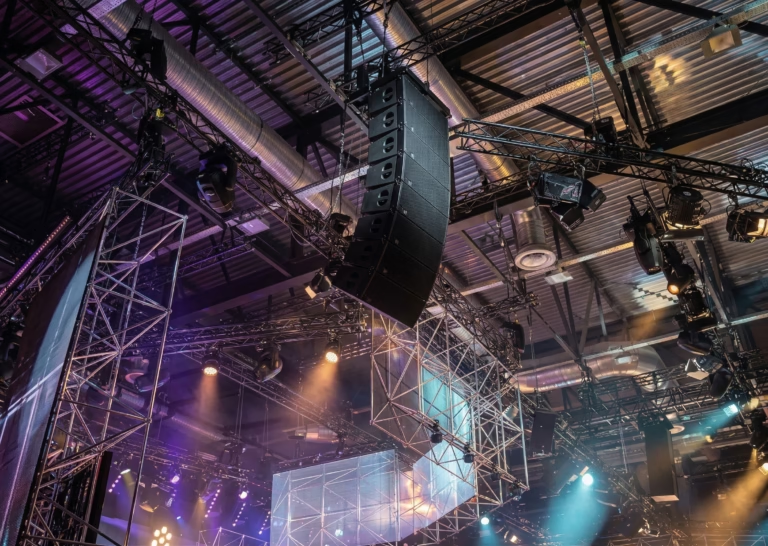
- Beam steering and line array direct sound at the audience in large rooms.
- Audio, microphones, image, and control are designed together and run by scenes.
What an auditorium’s sound needs to achieve
A good auditorium sound system isn’t measured by power. It’s measured by intelligibility: a sentence spoken on stage has to be fully understood at the last seat, without the front rows getting an uncomfortable volume.
Achieving that combines three things: speakers that cover the room evenly, a processor that adjusts delays and equalization by zone, and microphones suited to each type of speaking. If any one of the three fails, dead spots or feedback (the squeal from the stage return) show up.
Room acoustics come first
Walls, ceiling, seating, and stage shape decide how sound behaves. An auditorium with a high ceiling, glass, or a hard floor reflects the voice, and that reverberation blurs words together even at the right volume.
That’s why design starts with an assessment of the space. The room’s geometry and materials determine whether acoustic treatment is needed, where speakers go, and which system type fits.
Key idea
Turning up the volume doesn’t fix a room that echoes. Speaker placement, directivity, and, when needed, acoustic treatment do.
Distributed speakers, line array, or beam steering
The speaker type is chosen by room size and by how much control is needed over where the sound goes. These are the three configurations we use most in auditoriums.
| Criterion | Distributed speakers | Line array | Beam steering |
|---|---|---|---|
| How it covers the room | Several ceiling or wall speakers, each covering a zone | A column of aligned speakers that projects sound far and evenly | A column whose sound beam is aimed by software |
| When it’s worth it | Small and medium rooms with low ceilings | Large auditoriums and events with music | Rooms with heavy reverberation or zones that shouldn’t receive sound |
| What it requires | Good distribution and zone delays | Structure and coverage calculations | Beam programming and networked equipment |
Beam steering: sound goes where the audience is
Beam steering electronically controls the direction of a speaker column’s sound beam. Software defines where the sound reaches, with no need to physically tilt the speakers, and two independent beams can be created for different zones.
By directing sound at the audience instead of walls and ceiling, bounce is reduced and the voice gains clarity. We work with Fohhn for this, in its Focus series.
Real case
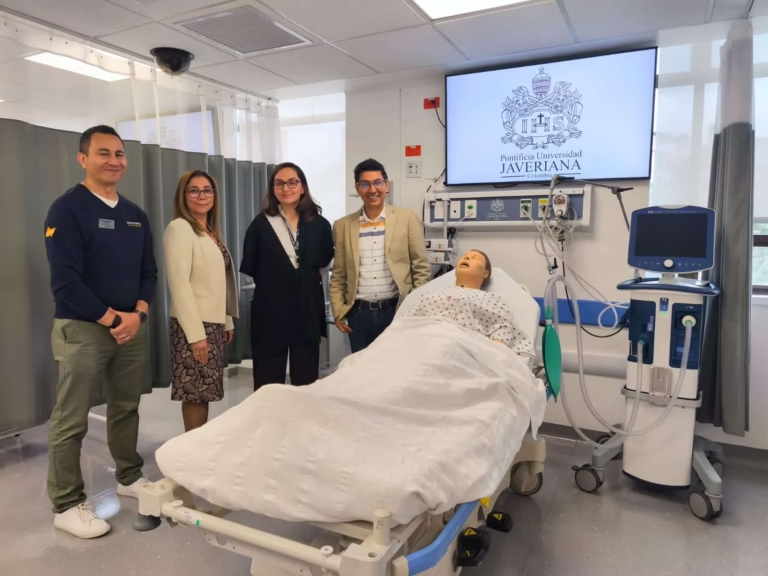
At Universidad Javeriana’s outdoor LED screen, Fohhn audio directs sound at the audience without affecting the clinic or nearby classrooms.
Microphones by event type
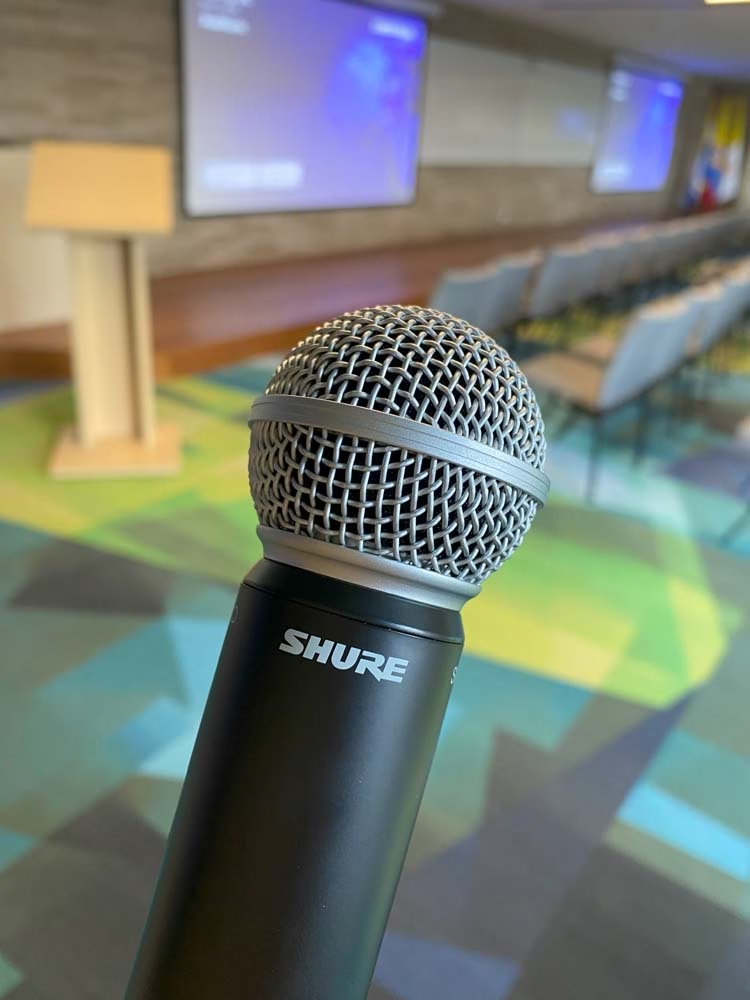
- Handheld and lapel
- Wireless, for speakers moving around the stage and for audience Q&A.
- Table
- For panels and discussions, one microphone per guest, turned on from the control panel.
- Delegate
- One microphone per seat in assembly rooms, with speaking-turn management and session recording.
All of them run through a digital signal processor (DSP) that controls feedback, cancels echo when there are remote participants, and levels voices. Reference brand for microphones: Shure; for amplification, Powersoft.
Video, in the same scene as audio
The image is sized by the distance to the back row and the room’s light; we cover that in the projector for auditoriums guide. What matters here is that image and sound respond to the same command.

When the operator selects the video scene, the system dims the lights, switches the screen’s source, and raises the content’s audio. If the event is recorded or streamed, the cameras and audio mix come from the same system.
How an auditorium’s audio and video is designed
- AssessmentCapacity, event types, room drawings, materials, network, and equipment that can be reused.
- DesignSpeaker and microphone placement, the audio and video chain, and floor plans, single-line diagrams, and schematics in AVIXA notation.
- ProgrammingAudio, video, and light scenes on the Crestron panel, agreed with whoever runs the auditorium.
- Installation and tuningInstallation, room equalization, and level testing at different points in the audience.
- Training and after-sales supportHandover with the team trained and support with agreed response times.
You may also be interested in
Frequently asked questions about auditorium sound
What sound system does an auditorium need?
Whichever one delivers the same level and clarity at every seat. Small rooms just need distributed speakers; large auditoriums or ones with heavy reverberation use line-array columns or beam steering, always with audio processing and microphones matched to the events.
What is beam steering?
It’s technology that aims a speaker column’s sound beam by software. It lets you direct audio at the audience and away from walls, ceiling, or zones that shouldn’t receive it, with no need to physically move the speakers.
Can an auditorium’s sound be improved without replacing all the equipment?
Often, yes. We check which speakers and cabling are in good condition and focus the investment on processing, microphones, speaker placement, or acoustic treatment, which are usually the actual cause of the problem.
Let’s Design Your Auditorium’s Sound and Video
In the first conversation we review the capacity, acoustics, light, and equipment your auditorium already has. From there we deliver a proposal with scope, drawings in AVIXA notation, schedule, and after-sales model.
Request a Technical Consultation Message us on WhatsApp
Bogotá and Medellín · +57 301 656 9858