Boardroom microphones pick up the voice of every seat so the meeting sounds clear in the room and on the video call. The main types are table, ceiling array, gooseneck and wireless, and they are chosen by the size of the table, the room acoustics and the way people meet.
The microphone is one part of the audio in a smart boardroom, together with the processor, speakers, camera and control. That is why it is designed with the rest of the system rather than picked from a catalog.
In short
- A good microphone captures the person speaking and leaves out room echo and noise.
- Table or ceiling microphones for meeting rooms, goosenecks for formal boards and wireless for presenting on your feet.
- On video calls, echo cancellation matters as much as the microphone.
- They are chosen with the table, the acoustics and the video conferencing platform in view.
Why the microphone defines the quality of a meeting
In a hybrid meeting, remote participants only hear what the microphone picks up. If the microphone is too far away, it captures the air conditioning, the echo off glass walls and the neighbor’s keyboard before the voice.
Each microphone captures sound with a different pattern. An omnidirectional one, often called an ambient microphone, listens in every direction; a directional one listens to the front and reduces what comes from behind.
Key idea
The voice has to reach the microphone louder than the room noise; everything else is adjusted afterwards.
Types of boardroom microphones
These are the four types most often installed in boardrooms and meeting rooms.
Table
It sits on the meeting or conference table and picks up the people seated around it. The most common choice for mid-size rooms.
Ceiling array
It forms pickup zones over each seat from the ceiling. The table stays free of cables and devices.
Gooseneck
One microphone per seat, with a push-to-talk button. Used in boards of directors, councils and delegate rooms.
Wireless
Handheld or lavalier, for whoever presents standing up or to pass the floor. It needs a receiver and battery management.
What a microphone array is
A microphone array combines several capsules in a single device. With digital processing it forms pickup beams aimed at each seat, a technique called beamforming, and reduces what comes from other directions.
In meeting rooms, Shure’s Microflex Advance series applies this principle in ceiling and table versions. Its IntelliMix processing cancels echo, reduces noise and automatically mixes the voice of whoever is speaking, so people talk naturally without leaning into the microphone.
You may also be interested in
Shure microphones: types and how to choose them for rooms, classrooms and auditoriums
How to choose the microphone for the room
The starting point is the table: its length, how many people sit at it and where the screen is. With that, you choose between three setups.

- Small room
- A video conferencing bar with built-in microphones is usually enough if the table is short and everyone sits close to the screen.
- Mid-size room
- Table microphones or a ceiling array, connected to a processor that cancels echo. They cover the whole table without anyone leaning in.
- Large room or board
- Ceiling arrays by zone or a gooseneck per seat, with automatic mixing so only the microphone of the person speaking opens.
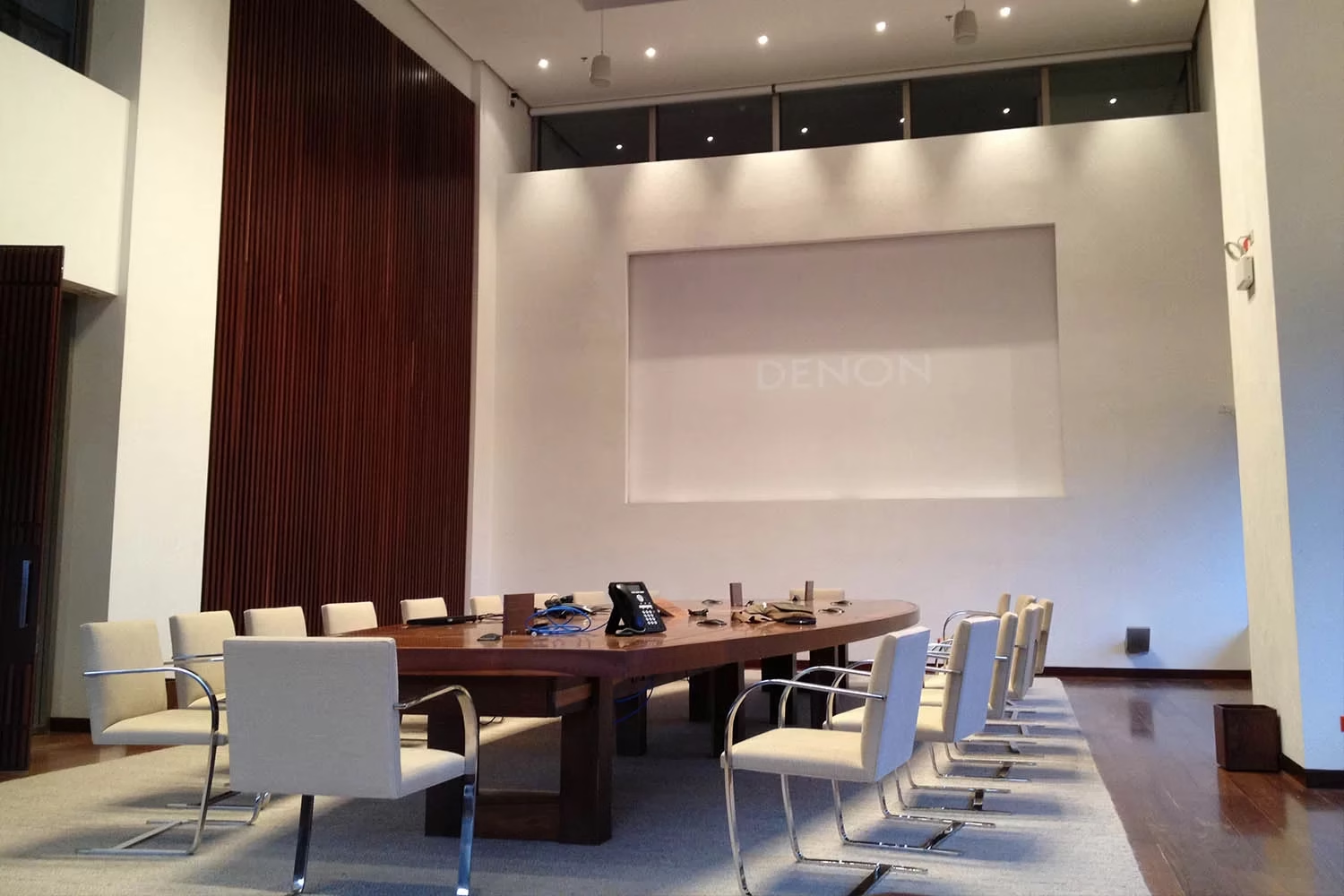
Besides size, acoustics and furniture matter. High ceilings, glass walls and hard floors bounce the voice back; in those rooms, microphone placement and acoustic treatment matter as much as the device.
Microphones for video conferencing rooms
On a video call the microphone works together with the speakers. Without echo cancellation, the remote participant’s voice comes out of the speakers, goes back into the microphone and returns to the call; that is why microphone, processor and platform are configured together.
We are Microsoft Teams Rooms and Zoom Rooms partners, and we distribute Cisco and Poly, whose room systems include built-in microphones and accept extra microphones for long tables. We explain it in our video conferencing rooms for companies and in Crestron video conferencing, where mute, volume and source are handled from the same panel that controls the room.
Installation: where audio is won or lost
The microphone is placed once the table and chairs are defined: the distance to each seat, the ceiling height and noise sources such as air vents or projectors. Cabling runs through the table or the ceiling so nothing is left in sight.
Then levels, pickup zones and echo cancellation are tuned with the room in use, and the people who operate it are trained. Preventive maintenance then checks batteries, receivers, cabling and levels.
Key idea
A microphone is tested with a full room and the video call open, not in the catalog.
Frequently asked questions about boardroom microphones
Which microphone is best for a boardroom?
It depends on the size of the table and the acoustics. In mid-size and large rooms, ceiling or table array microphones with echo cancellation work well; in formal boards, a gooseneck per seat; in small rooms, the video conferencing bar may be enough.
How many microphones does a meeting room need?
It depends on the length of the table, the number of seats and the type of microphone. A ceiling array covers several people per zone; goosenecks go one per seat or one for every two. The number comes from the design, using the room drawings.
What is an ambient microphone for a boardroom?
It is an omnidirectional microphone: it captures sound in every direction. It suits small tables and informal meetings; in rooms with echo or noise, a directional microphone or an array that focuses on each seat is a better choice.
Which microphones isolate noise best?
Directional microphones and beamforming arrays, because they only capture the zone where the speaker is. If they also run through a processor with noise reduction and echo cancellation, the meeting sounds clean in the room and on the call.
Do wireless microphones work in a boardroom?
Yes, for whoever presents standing up or to pass the floor. They need receivers, well-assigned frequencies and battery management; for the fixed seats at the table, a table or ceiling microphone is the better fit.
Let’s design the audio for your boardroom
We review the table, the acoustics and the video conferencing platform your team uses, and propose the microphones, processing and installation. If you already have equipment in good condition, we integrate it into the new system.
Request a technical consultation Message us on WhatsApp
Bogotá and Medellín · +57 301 656 9858